OSHA Inspectors
Workplace conditions for construction and general industry, with employer coverage and the selected state’s OSHA or State Plan references.
Start OSHA assessmentFollow one clear workflow. Each short demonstration uses different imagery and examples selected for this industry.
Support OSHA inspectors, FDA inspectors and other industrial, hygiene and safety consultants with separate assessment workflows, uploaded requirements and source-linked reporting.
Illustrative image and finding; not a live assessment or compliance result.
Workplace conditions for construction and general industry, with employer coverage and the selected state’s OSHA or State Plan references.
Start OSHA assessmentChoose the facility and product type: food manufacturing, retail food, drugs, medical devices or cosmetics. Research relevant FDA requirements or the adopted state/local food rules.
Start FDA assessmentIndustrial, Hygiene, Safety Consultants and other reviewers: describe your scope and upload PDF or Excel directions, guidelines, standards or contract requirements for comparison with your photos or video.
Start other inspector assessmentUpload customer directions, guidelines, standards or contract requirements as PDF or Excel files. TruInspector Ai uses the relevant requirements alongside your photos and recorded videos to support a focused assessment.
Choose your industry and assessment type on Evaluations. Upload up to three PDF or Excel (.xlsx or .xls) documents, up to 5 MB each. Available for every industry and sector.
Identify the site, location and relevant area. Add photos or recorded video, select the assessment type, and attach your requirements for any specific priorities.
Relevant findings identify the customer document and available page, section or worksheet reference, explain the visible concern, and list corrective actions and missing field checks. Download the report as PDF or Excel.
Customer requirements are identified separately from official regulations. Confirm the applicable edition and scope; an upload does not establish legal applicability or certify compliance. Attachments stay within your signed-in workspace and are not included in public picture links.
Excel review uses up to the first 1,000 rows per worksheet and may summarize the content; embedded pictures and charts are not read. Export important diagrams and longer requirements sections as PDF. Use clear, unlocked documents and check source references in the report. Unreadable content, missing measurements, concealed conditions and requirements outside the evidence remain unverified. This is an assisted visual review, not a complete contract audit.
These examples match this industry or specialty workflow. Each includes a detailed preliminary observation, inspector checks, recommended work and a closeout record. Use the arrow to hide or show the details.
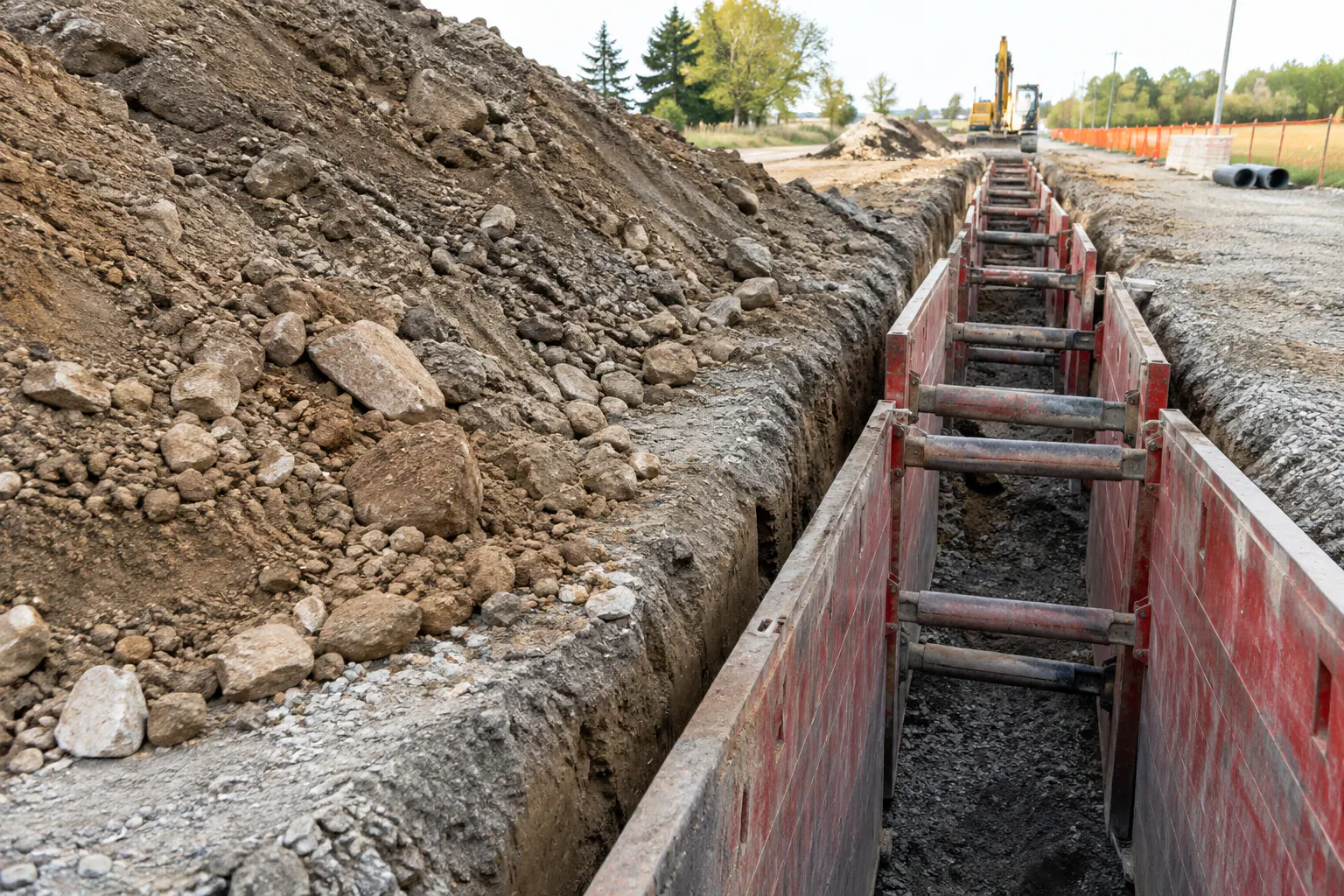 Excavated soil piled close to an open trenchThe spoil mound sits close to the trench edge; falling or rolling material is a potential concern.Read picture report
The left side of the linked construction photo contains a substantial spoil mound beside the open, braced trench. The toe of the mound approaches the excavation, and loose material is visible around the edge. Material could fall or roll into the excavation if workers are exposed. The photo does not establish the actual setback, the effectiveness of retaining measures, soil stability or whether anyone is working below.
1. Have the site’s competent person review the spoil placement and worker exposure before allowing access below. 2. Measure the separation from the trench edge and check whether the visible support also provides suitable retention of loose material. 3. Relocate the spoil or provide the required retention under the site’s excavation plan. Keep workers out of the affected area while the arrangement is corrected. 4. Recheck the edge and protective system after the change. 5. Document the measured setback, controls and site review with an overview photograph.
Retain measured setback, the competent person’s review and photographs of the corrected spoil arrangement.
Applicable requirement: 29 CFR 1926.651(j)(2) addresses protection from materials or equipment falling or rolling into excavations. Measure setback and verify retaining measures and worker exposure before deciding compliance. An illustrative image does not establish a field measurement or compliance result.
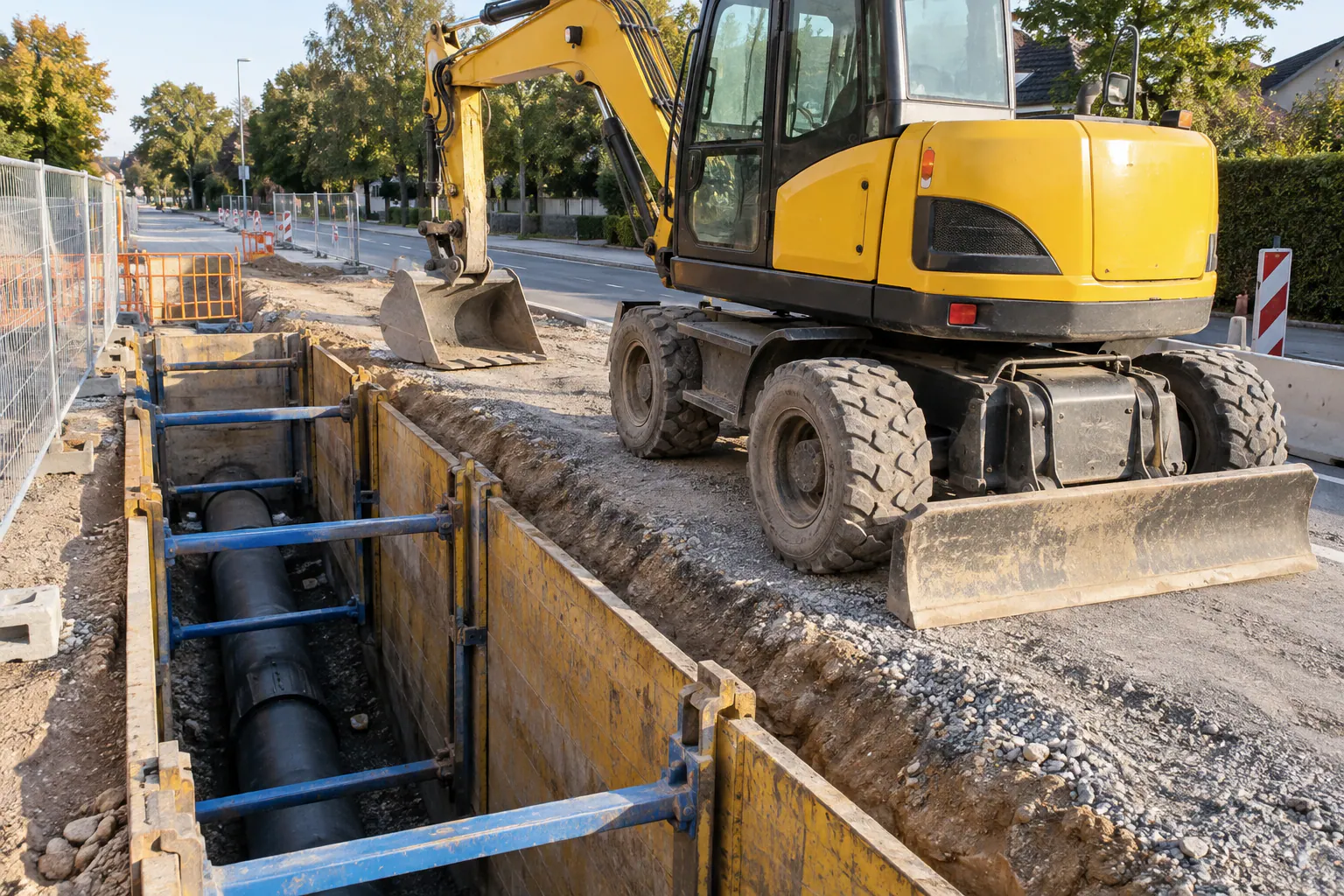 Heavy equipment positioned beside the trenchThe excavator’s wheels and blade sit close to the edge of an open, braced utility trench.Read picture report
The excavator occupies the ground immediately alongside the open trench. Its near-side wheels and blade are close to the edge, above the trench bracing and exposed utility pipe. Equipment loading could affect the ground at the edge, and planned movement may create equipment-to-edge or equipment-to-person conflicts. The still image does not establish whether the machine is moving, its measured clearance, the operator’s sight line, ground capacity or the adequacy of the excavation protection. Those conditions need an on-site review before deciding whether repositioning or additional controls are required.
1. Have the supervisor and competent person assess equipment positioning, planned movements and nearby worker access. 2. Measure the edge clearance and verify that the working surface and excavation arrangement suit the equipment loading. 3. Confirm the operator’s sight line and the warning or separation arrangements required for the actual operation. 4. Adjust the equipment position or access controls where the review identifies a conflict. 5. Record the approved arrangement, brief affected personnel and photograph the full operating area before work resumes.
Record the verified equipment arrangement, visibility review and controls, with photographs showing the machine, edge and worker route.
Applicable requirement: 29 CFR 1926.651(f) addresses warning systems when mobile equipment approaches an excavation without a clear operator view of the edge. Verify those conditions before applying the provision. An illustrative image does not establish a field measurement or compliance result.
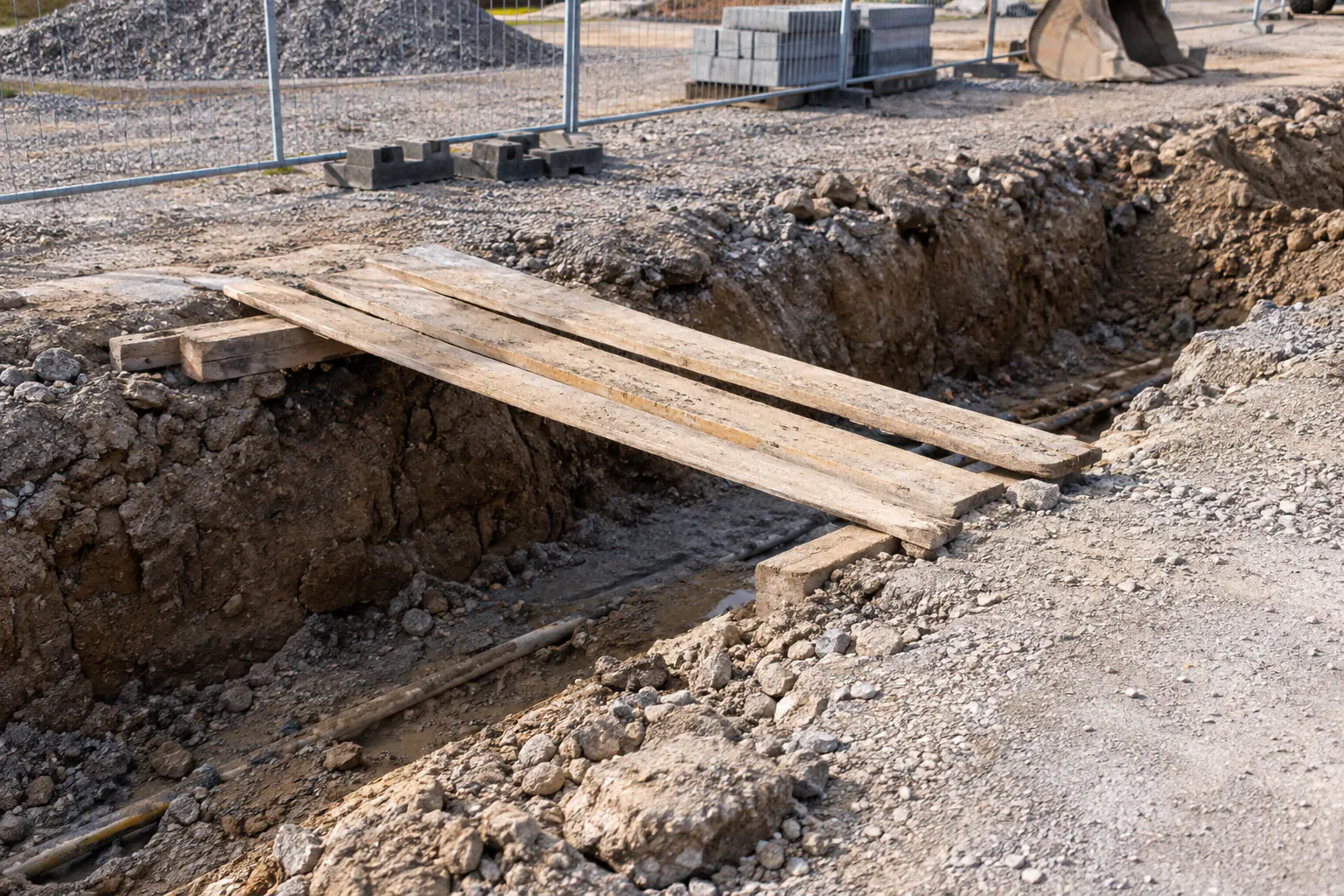 Boards across the excavation need crossing verificationBoards span the foreground trench, but their suitability as a pedestrian crossing is unverified.Read picture report
The planks bridge the excavation on short timber supports, with gaps between boards and an uneven walking surface. No side protection is visible, and loose soil and stones surround both approaches. If this is a designated crossing, its stability, width, load capacity and required protection need verification. The photograph cannot establish fastening, timber condition below the surface, measured height over the lower level or whether an approved alternative route is available.
1. Confirm whether workers or equipment are permitted to use the boards as a crossing. 2. If access is intended, have the competent person verify its construction, support, width, fastening and height before use. 3. Provide the required crossing and protective arrangements, or close this route and direct people to an approved alternative. 4. Remove trip conflicts from the approach as part of the access arrangement. 5. Record the verified crossing, access instructions and photographs showing both approaches and the excavation below.
Document the competent person’s crossing review, measurements and photographs of the complete approved route.
Applicable requirement: 29 CFR 1926.651(l) addresses crossings over excavations and protection at qualifying heights. Confirm intended use, measured height and the installed arrangement before determining compliance. An illustrative image does not establish a field measurement or compliance result.
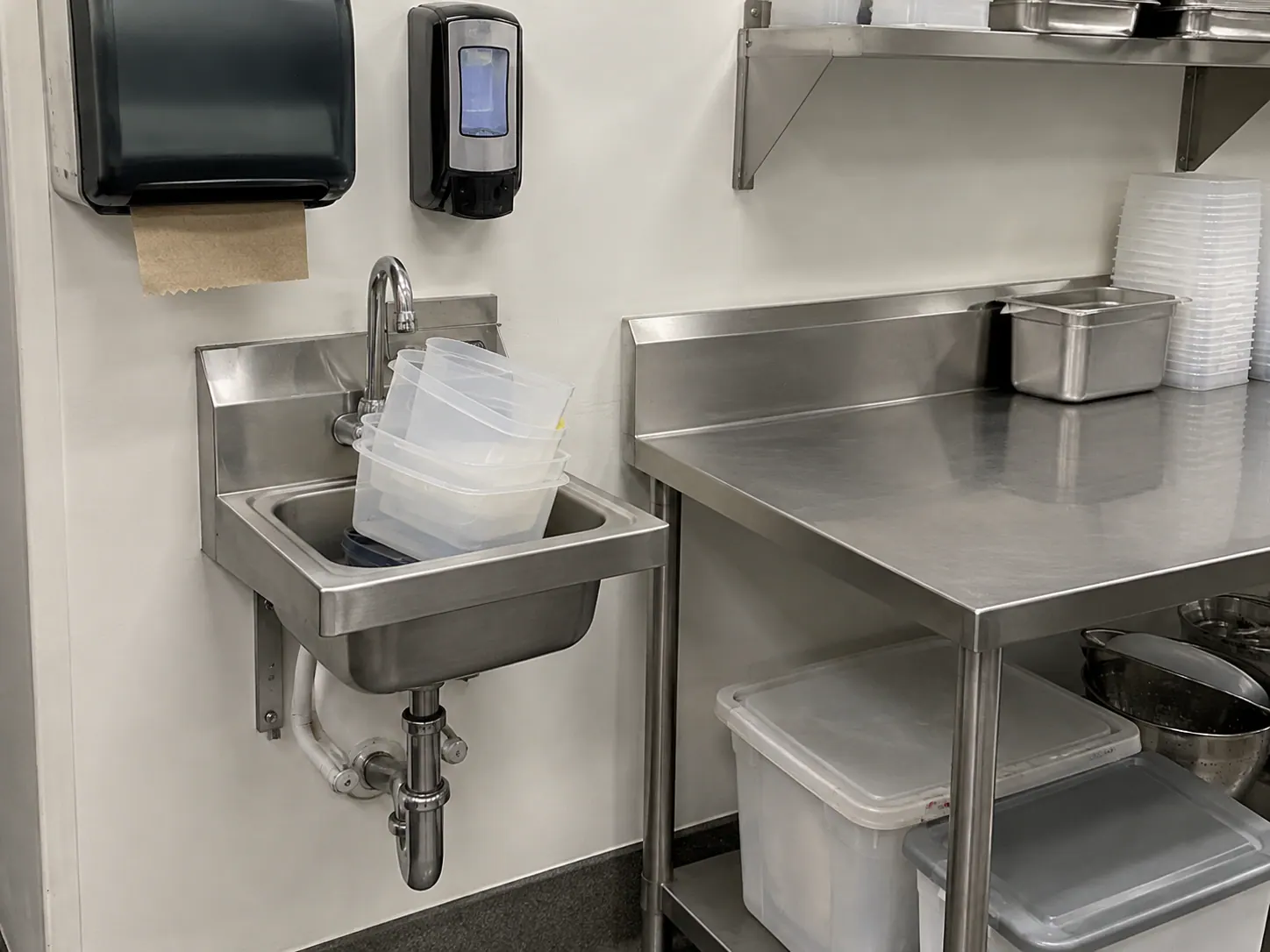 FDA / retail-food example — handwashing accessFood-storage tubs occupy the handwashing basin and obstruct its intended use.Read picture report
The illustration shows plastic food-storage tubs stacked inside a small handwashing sink beside a preparation counter. The basin cannot readily be used for normal handwashing while the tubs remain there. Soap and towel dispensers are visible, but the photo cannot confirm supply, water temperature, flow, employee practices or contamination.
Move the tubs into appropriate clean storage so the sink can be used. Clean and restore the basin as required by the facility’s procedures, verify water and supplies, and review the storage practice with responsible staff. Add suitable storage capacity or identification if needed, without obstructing food-preparation or circulation areas. Do not infer product contamination or prescribe a recall from this image.
Photograph the restored sink, record operational checks and the applicable requirement, and document the responsible reviewer’s corrective-action follow-up.
Applicable requirement: Retail food generally uses state/local adopted food requirements. FDA’s Food Code is a model; food manufacturing has a different regulatory context. An illustrative image does not establish a field measurement or compliance result.
All images and findings are illustrative. They show report structure and inspection topics, not actual field evidence or a compliance decision.
Detailed observations, location fields, practical recommendations and a standards assessment for every finding. Download your assessments as PDF reports with photos or Excel workbooks with picture links. Explore the three-row Excel examples below.
| Location / sample GPS | Potential finding | Recommended next step |
|---|---|---|
| Site A example · Left of trench28.538300 -81.379200 | Excavated soil piled close to an open trenchThe spoil mound sits close to the trench edge; falling or rolling material is a potential concern. | Measure the setback and have the competent person verify material retention and access.Picture |
| Site A example · Right trench edge28.538400 -81.379100 | Heavy equipment positioned beside the trenchThe excavator’s wheels and blade sit close to the edge of an open, braced utility trench. | Verify edge clearance, ground support, operator visibility and worker separation.Picture |
| Site A example · Foreground crossing28.538500 -81.379000 | Boards across the excavation need crossing verificationBoards span the foreground trench, but their suitability as a pedestrian crossing is unverified. | Confirm their use and verify a suitable crossing and required protective measures.Picture |
Site A example · Left of trench · Illustrative location; see the picture for the observation area
Sample GPS: 28.538300, -81.379200
29 CFR 1926.651(j)(2) addresses protection from materials or equipment falling or rolling into excavations. Measure setback and verify retaining measures and worker exposure before deciding compliance.
Site A example · Right trench edge · Illustrative location; see the picture for the observation area
Sample GPS: 28.538400, -81.379100
29 CFR 1926.651(f) addresses warning systems when mobile equipment approaches an excavation without a clear operator view of the edge. Verify those conditions before applying the provision.
Site A example · Foreground crossing · Illustrative location; see the picture for the observation area
Sample GPS: 28.538500, -81.379000
29 CFR 1926.651(l) addresses crossings over excavations and protection at qualifying heights. Confirm intended use, measured height and the installed arrangement before determining compliance.
Each finding links to its own illustrative picture, including Ai-generated demonstration scenes. Descriptions identify visible conditions; location labels and GPS are fictional examples. Field verification is required before deciding compliance or corrective work.
Use a consistent record to support the people responsible for assessing and addressing site conditions.
Select construction or general industry, state and employer type so the assessment researches applicable OSHA or State Plan requirements.
Select food manufacturing, retail food, drugs, medical devices or cosmetics. Match the facility activity to relevant FDA or state/local requirements.
Keep visible concerns, official references, required tests or records, corrective steps and closeout evidence together.
Findings support qualified review. OSHA coverage depends on work and employer; FDA requirements depend on the product and facility activity. Retail-food requirements are generally administered by state/local agencies. TruInspector does not issue official citations, approvals or compliance certifications.
Review applicable sourcesReference resources: OSHA State Plans and FDA and state/local retail-food oversight. Apply the requirements relevant to your jurisdiction and work.
Use printable checklists, report examples and documentation guides built around this workflow.
Turn photos and recorded video into a reviewable condition record. Keep visible findings, evidence, recommended actions and follow-up together.
Share observations and supporting pictures in a report your team can review.
Keep category, condition, description and action notes organized. Include location and GPS when supported by the evidence.
Classify mixed photos, review separate asset reports and track work status in the Data Hub.